“What size bin do I need?” is the question we get more than any other, and the honest answer is that most people ask it the wrong way round. They picture the pile in the garage and try to match it to a number of cubic yards. The better approach is to start with what the material is, because weight not volume is what usually decides the job.
Here are five job types we handle constantly across Abbotsford, Chilliwack, Mission and Maple Ridge, and the bin each one actually needs.
The kitchen and bathroom gut — 15 yard
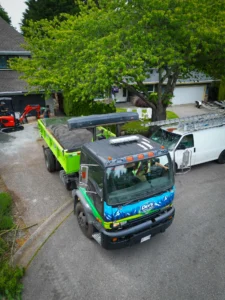
Interior renovations are the bread and butter of bin work in Abbotsford, and Clearbrook in particular is full of 1970s and 1980s houses coming up for their second or third kitchen. A typical job: cabinets out, countertop out, flooring up in the kitchen and two bathrooms, plus the vanity, tub surround and a fair amount of drywall.
The instinct is to order the biggest bin available. On a job like this a 15 yard is almost always right. Cabinets are bulky but light. Old vinyl and underlay is light. The weight comes from tile, mortar bed and drywall, and those three will fill a scale faster than they fill a bin. Order a 30 yard for a kitchen gut and you spend the extra space hauling air.
The wrinkle on older homes is drywall. Built before the mid 1990s, the drywall and joint compound may contain asbestos, and in British Columbia that turns a disposal question into a workplace safety one. Test before demolition, not after the bin is full. Our bin rental Abbotsford page covers the local specifics.
The roof tear-off — 10 or 15 yard
Roofing is the clearest example of why volume and weight are separate problems. A single layer of asphalt shingles off an average Sardis rancher looks like a small load in a 15 yard bin barely halfway up the walls and is still one of the heaviest things we haul all week. Shingles run roughly two to three tons for a typical single family tear off, more if the roofer finds a second layer underneath.
So we would rather put a 10 or 15 yard on a roof job than a 30. A bin physically full of shingles is over legal road weight, and nobody wins that argument with a scale. Two smaller bins swapped mid-job cost less grief than one oversized bin that cannot leave the property. If you are pricing a roof job locally, see bin rental Chilliwack for what disposal runs there.
The hillside yard clearing — 20 yard
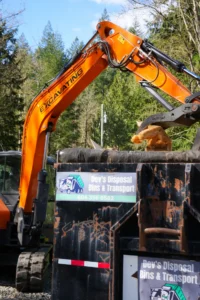
Mission jobs are access jobs. Between Hatzic, Cedar Valley and the properties running up toward Steelhead, a good number of our drops are on sloped driveways, gravel, or a shared lane never designed for a roll-off truck.
A classic one: a couple who bought an acre on the hillside and spent a summer losing to blackberry. By the time they called they had a decade of overgrowth, a rotted shed, an old fence line and a pile of yard waste quietly composting behind the garage.
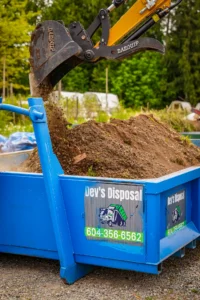
Green waste is deceptive. Bulky going in, and it settles a 20 yard that looked full on Saturday will have dropped six inches by Monday. It is also wet, especially after a Fraser Valley winter, and wet vegetation is heavy. Cut it down rather than piling it in. Chopping branches short and stacking rather than tossing can gain you a third more capacity in the same bin.
The basement suite build — 20 yard
Albion and Silver Valley are full of newer homes where a basement is getting finished or refinished as a rental. That produces framing offcuts, drywall, old flooring and packaging light, bulky material where a 20 yard makes sense and where you will run out of room long before you run out of weight.
This is the one job type where going up a size is nearly always the right call. Because our rental rate is flat regardless of size, a bigger bin costs you nothing but driveway space. See bin rental Maple Ridge for delivery details in that area.
The full house or acreage cleanout — 30 yard
Estate cleanouts, downsizings, and long-held family homes going to market. Out past the city limits it is barn clean outs, old outbuildings, fencing, and the accumulated equipment of someone who has had the same forty acres for thirty years.
These need a 30 yard, and they need a conversation first, because acreages come with the two things that complicate a drop: soft ground and long driveways. A loaded roll off will sink into a wet field, and a driveway a pickup handles fine is not necessarily one a truck can turn around in.
Cleanouts are also where prohibited items surface paint in the crawlspace, a propane tank behind the shed, a bar fridge in the garage. None of that can go in a disposal bin, and a load flagged at the scale can be rejected entirely.
The short version
- 8 yard — one room, one bathroom, a small deck.
- 10 yard — three to five pickup loads, or any heavy demolition material.
- 15 yard — six to eight pickup loads. Kitchens, roofs, medium cleanouts.
- 20 yard — up to ten pickup loads. Basements, whole floors, yard clearings.
- 30 yard — up to fifteen pickup loads. Full houses, acreages, commercial sites.
Between two sizes? Go up when the material is bulky and light. Go down when it is heavy shingles, tile, concrete, wet soil because you will hit weight limits first.
Or skip the arithmetic: describe the job and we will size it for you. We deliver across bin rental Fraser Valley from our yard in Mission. Call (604) 356-6562 or email devsdisposal@gmail.com.